SDACOMM GROUP LIMITED
Email: sda@sdacomm.com
Tel: +852-6931 0574
Fax: +852-6931 0574
Address: Room B3, 19/F, Tung Lee Commercial Building, 91-97 Jervois Street, Sheung Wan,Hong Kong
11
December, 2024CANADIAN YELLOW PEAS FOR THE 2024 SEASON, FOCUSING ON PLANTED AREA (ACREAGE), PRODUCTION, AND EXPORTS, USING THE MOST RECENT DATA TRENDS AND PROJECTIONS AS A BASIS.
1. Planted Area (Acreage)
Historical Context
- In 2023, Canada's total pea acreage
(including yellow peas) was approximately 3.6 million acres, with yellow peas
accounting for around 75-80% of the total, making them the dominant
variety.
- Saskatchewan and Alberta are the leading
provinces for pea cultivation, contributing over 85% of the total planted area
in Canada.
2024 Projections
- Estimated Planted Area:
For
2024, the total planted area for peas is expected to remain in the range of 3.5
to 3.8 million acres, as farmers balance strong demand for pulses with
competition from other crops like wheat, canola, and lentils.
- Factors Influencing Acreage:
- Positive
Factors:
-
Continued demand from international markets like China and India.
-
Favorable pricing trends in 2023, which provide incentives for farmers.
- Negative
Factors:
-
Competition for arable land from other profitable crops such as durum wheat and
barley.
-
Potential input cost pressures (e.g., fertilizer and fuel prices).
- Regional Breakdown:
- Saskatchewan:
Expected to account for 55-60% of total pea acreage (~2.0–2.2 million acres).
- Alberta:
Around 25-30% (~0.9–1.1 million acres).
- Manitoba
and Other Provinces: The remaining 10-15% (~0.3–0.5
million acres).
2. Production
Historical Context
- In 2023, Canadian pea production was
approximately 3.4 million metric tons, a recovery from the drought-affected
2021 and 2022 seasons.
- Yellow peas typically account for 85-90%
of total pea production, making them the largest segment.
2024 Projections
- Estimated Yield:
Assuming normal weather conditions, average yields are projected to
range between 38 and 42 bushels per acre (or ~2.5 to 2.8 metric tons per
hectare).
-
In 2023, yields averaged around 39 bushels per acre, and similar or slightly
higher yields are expected in 2024 with favorable weather.
Based on planted acreage of 3.5–3.8 million
acres and average yields of 38–42 bushels/acre, total
production of peas in Canada is projected to be 3.2 to 3.8 million metric tons.
-
Yellow peas are expected to contribute 2.8 to 3.4 million metric tons to this
total.
- Weather:
Adequate spring moisture and timely rainfall during the growing season will be
critical.
- Input
Costs: High input costs could limit fertilizer application, potentially
affecting yields.
- Disease
Pressure: Diseases such as root rot and ascochyta blight could reduce yields if
not managed properly.
3. Exports
Historical Context
- Canada is the largest exporter of yellow
peas globally, with exports typically accounting for 80-90% of total
production.
- In 2023, Canadian pea exports totaled
approximately 2.6–2.8 million metric tons, driven
largely by demand from China, India, and smaller markets like Bangladesh and
Pakistan.
2024 Projections
- Estimated Export Volume:
Exports in 2024 are projected to remain strong, ranging between 2.5 and
3.0 million metric tons, depending on production levels and global market
demand.
- China:
-
China remains the largest buyer of Canadian yellow peas, importing
approximately 1.2–1.4 million metric tons annually for
use in livestock feed and starch production.
-
Demand from China is expected to remain steady in 2024, especially as pea
protein gains popularity in the food and beverage industries.
- India:
-
India is a significant but volatile market due to its fluctuating import
policies.
-
In recent years, India has imported 300,000–500,000
metric tons of Canadian peas annually when domestic production has fallen
short.
-
Import policies and tariff levels will heavily influence India's purchasing in
2024.
- Other
Markets:
-
Bangladesh, Pakistan, and the EU are expected to collectively import 500,000–700,000 metric tons of Canadian peas.
- Competition:
- Russia:
Russia has increased its pea production and exports in recent years, posing
competition to Canadian yellow peas in key markets like China and South
Asia.
- Australia:
Australia is also expanding its pulse exports, which could pressure Canadian
market share.
Summary Table
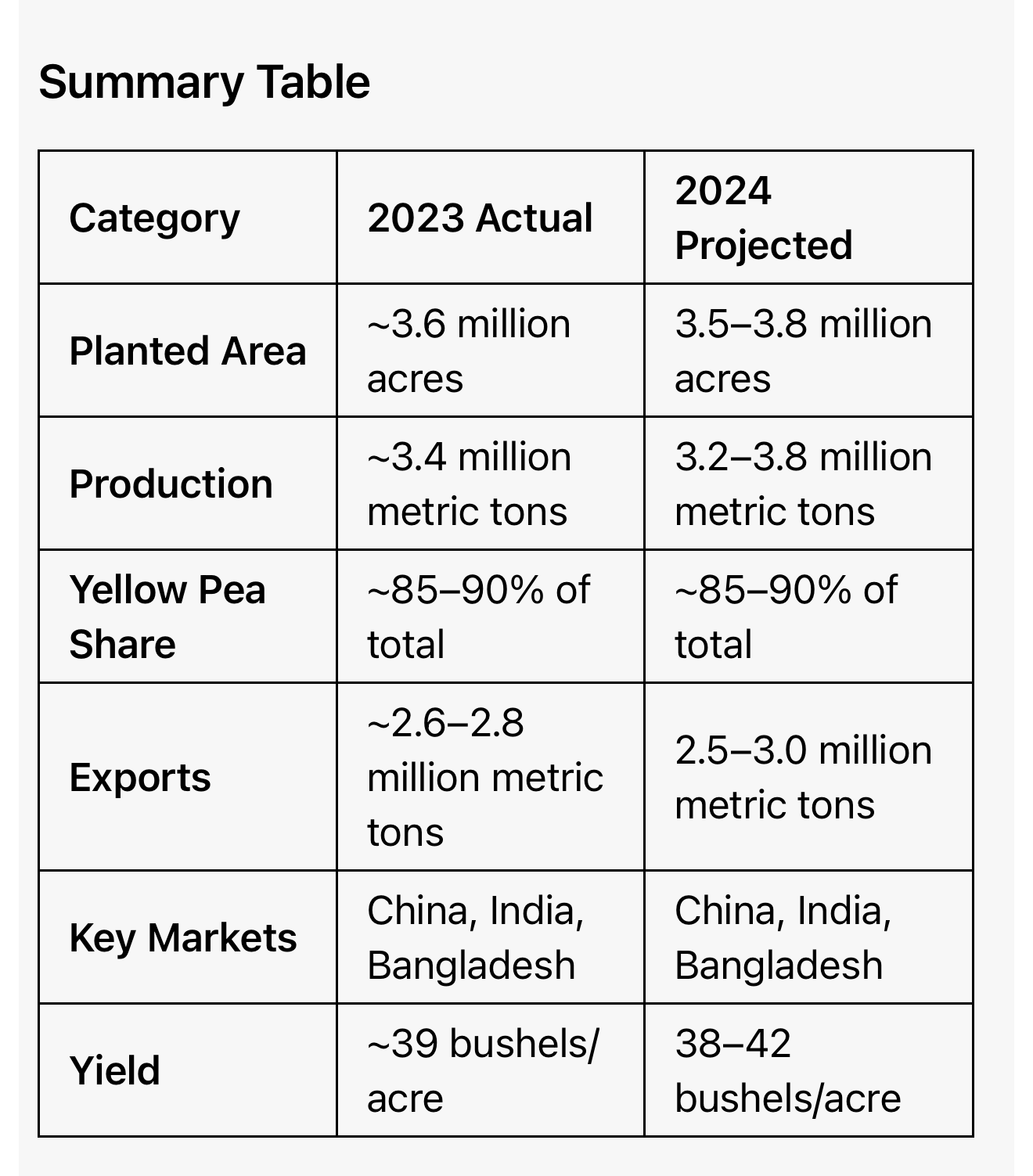
Key Risks to Watch
1. Weather Conditions: Prolonged drought or
excessive rainfall could reduce yields and total production.
2. Trade Policies: Import restrictions or
tariffs in key markets like India could limit export volumes.
3. Global Competition: Increased exports
from Russia and Australia could pressure Canadian market share.
4. Input Costs: High fertilizer and fuel
costs could reduce farmers' profit margins and influence planting
decisions.
This data-driven analysis highlights the potential for steady growth in Canadian yellow pea production and exports in 2024, but external factors like weather, global competition, and trade policies will play a critical role in shaping the final outcomes.